PNG Bahai Official Website

  • Increase font size
  • Default font size
  • Decrease font size
PNG Bahai Official Website

Trial of 7 Bahai leaders in Iran

E-mail Print PDF

The seven Iranian Baha’i leaders who formerly looked after the needs of Iran’s Baha’i community.

Trial of Iran’s seven
Baha’i leaders

On 5 March 2008, Mahvash Sabet – a schoolteacher and mother of two – was arrested having been summoned to the Iranian city of Mashhad to discuss some matters regarding a Baha’i burial. She has been in prison since that time – including the first 175 days spent in solitary confinement.

Two months later, on 14 May, six other prominent members of Iran’s Baha’i community were incarcerated in Tehran’s notorious Evin prison, after they were arrested in early morning raids at their homes in a sweep that was ominously similar to episodes in the 1980s when scores of Iranian Baha’i leaders were summarily rounded up and killed.

The six were Fariba Kamalabadi, Jamaloddin Khanjani, Afif Naeimi, Saeid Rezaie, Behrouz Tavakkoli, and Vahid Tizfahm.

These five men and two women were all members of a national-level group known as the “Yaran-i-Iran” – or “Friends in Iran”.

Some 20 months after being imprisoned without charge, a trial began on 12 January 2010. Throughout their long wait for justice, the seven had received hardly one hour’s access to their legal counsel and suffered appalling treatment and deprivations, including psychological and physical hardship.

The seven were charged with, among other things, espionage, propaganda against the Islamic republic, the establishment of an illegal administration - charges that were all rejected completely and categorically by the defendants.

Their crime, though, is nothing more than being members of the Baha’i Faith, a religion which has been the focus of a systematic, government-sponsored persecution in Iran since the 1979 revolution.

Indeed, the trial of the seven in many ways was the trial of an entire community of more than 300,000 Iranian Baha’is. Over the last 30 years, more than 200 Baha’is have been killed, hundreds more imprisoned, and thousands deprived of jobs, education, and the freedom to worship.

The charges against the seven moreover reflects the kinds of false accusations and campaign of misinformation that Iran’s regime has used to vilify and defame Baha’is for decades.

The trial of the seven Baha’i leaders ended on 14 June 2010 after six brief sessions, characterized by their lack of due legal process.

The reported sentences of 20 years imprisonment for each of the defendants has been met with outrage and condemnation throughout the world. The lawyers of the seven defendants are preparing an appeal.


In this special report:

This section of Baha’i World News Service includes articles and background information about the seven Iranian Baha’i leaders – their lives, their imprisonment and trial, and the allegations made against them. It tells their story as it unfolded over the past two years, as well as offering further resources about the persecution of Iran’s Baha’i community.

  • Chronology of Events – A chronology of the milestones in the imprisonment, trial and conviction of the seven Iranian Baha’i leaders, including the major international actions that have taken place in their defense.
  • Profiles – Biographical information about the seven prisoners.
  • Feature Articles – Articles exploring the background to the arrest and trial of the seven.
  • United Nations Statements – Statements by the UN General Assembly and Secretary-General, and from the Baha’i International Community.
  • Voices of Support – International calls in support of the seven imprisoned Baha’is.
  • Resources and Photos – Printable articles and photographs, for news media and other use.
Last Updated on Sunday, 05 September 2010 07:46
 

Reading from Baha'i writings

E-mail Print PDF

"THE FAST

These are the ordinances of God that have been set down in the Books and Tablets by His Most Exalted Pen.  Hold ye fast unto His statutes and commandments, and be not of those who, following their idle fancies and vain imaginings, have clung to the standards fixed by their own selves, and cast behind their backs the standards laid down by God.  Abstain from food and drink from sunrise to sundown, and beware lest desire deprive you of this grace that is appointed in the Book."

(Bahá’u’lláh, Kitáb-i-Aqdas, Paragraph 17, page 25)

Last Updated on Tuesday, 02 March 2010 21:26
 
E-mail Print PDF

How to become a Baha'i

Becoming a Baha'i is a very simple process.  Before taking this stop, however, one should thoroughly investigate the Faith, its sacred Writings, and become acquainted with the moral standards and laws of personal conduct that a Baha'i must follow.  Becoming a Baha'i is a serious commitment to both God and to ones self.

Both before and after enrollment it is essential to study and deepen one's understanding of the Baha'i sacred Writings.  The workbook Baha'i Essentials, available either from your local Baha'i community, or through the Baha'i Publishing Trust is a good start.  It's also a good idea to join a study class oriented towards new Baha'is.

To enroll in the Baha'i Faith, one makes a declaration of faith in their belief that Baha'u'llah is the Manifestation of God for this day and age, and their recognition of the stations of the other Central Figures of the Faith.  This is done by signing an enrollment card.  An example of the enrollment card is shown below:

Once the card has been sent to the Baha'i National Center in Port Moresby takes about 6 to 8 weeks depending on the volume of work at the National Center.  To obtain a declaration card and enroll, you may either contact your local Baha'i community, or contact the National Center as follows:

Private Mail Bag No. 9
Boroko. 111

Email: This e-mail address is being protected from spambots. You need JavaScript enabled to view it

Ph: 3250286
Fax: 3236474


if outside PNG see this link...

Last Updated on Saturday, 05 September 2009 12:13
 
E-mail Print PDF

Welcome

"The well-being of mankind, its peace and security, are unattainable unless and until its unity is firmly established." Baha'u'llah

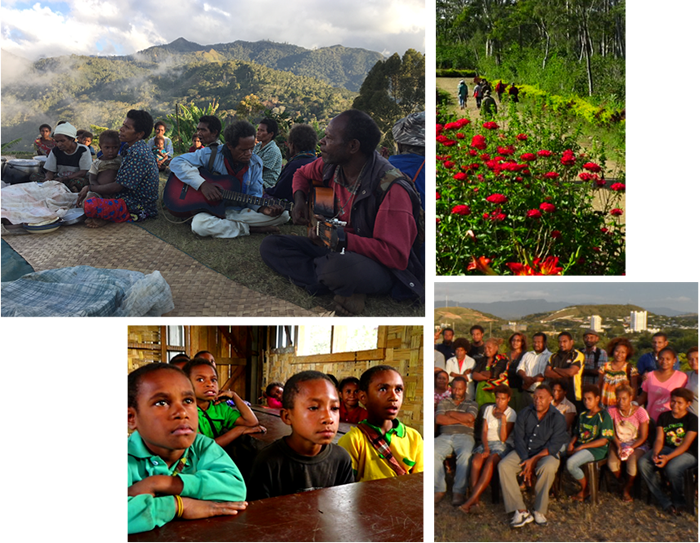
Tirang

A PNG village Baha'i


kids

PNG Baha'i kids performing

Last Updated on Tuesday, 08 September 2009 06:18
 
E-mail Print PDF

What is the Baha'i Faith?

Throughout history, God has revealed Himself to humanity through a series of divine Messengers, whose teachings guide and educate us and provide the basis for the advancement of human society. These Messengers have included Abraham, Krishna, Zoroaster, Moses, Buddha, Jesus, and Muhammad. Their religions come from the same Source and are in essence successive chapters of one religion from God.

Bahá’u’lláh, the latest of these Messengers, brought new spiritual and social teachings for our time. His essential message is of unity. He taught the oneness of God, the oneness of the human family, and the oneness of religion.

Bahá'u'lláh said, “The earth is but one country and mankind its citizens,” and that, as foretold in all the sacred scriptures of the past, now is the time for humanity to live in unity.

Founded more than a century and a half ago, the Bahá'í Faith has spread around the globe. Members of the Bahá'í Faith live in more than 100,000 localities and come from nearly every nation, ethnic group, culture, profession, and social or economic background.

Bahá'ís believe the crucial need facing humanity is to find a unifying vision of the nature and purpose of life and of the future of society. Such a vision unfolds in the writings of Bahá'u'lláh.  •

Last Updated on Saturday, 05 September 2009 12:16